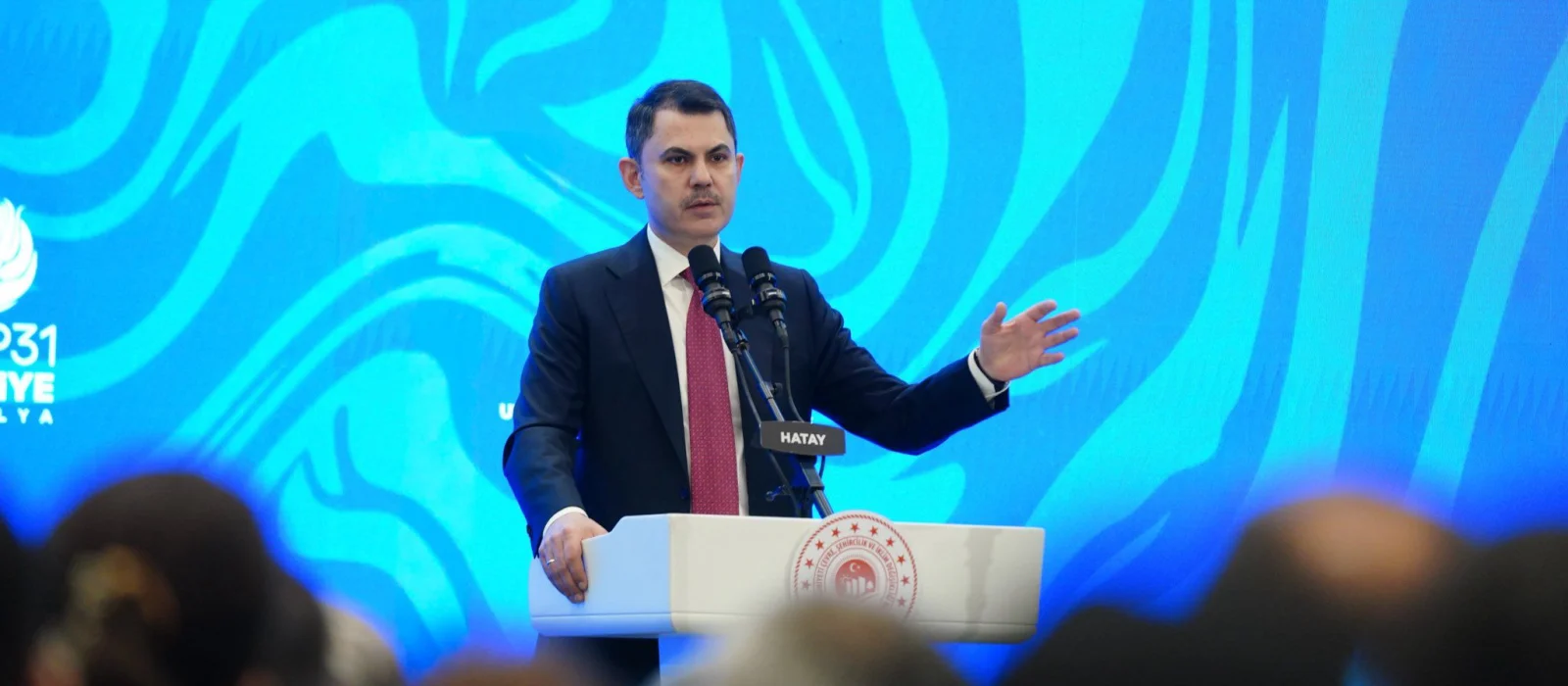
Delivered by COP31 President-Designate H.E. Murat Kurum at the high-level opening of the Resilient Cities Programme — Türkiye's Road to COP31, Hatay, 8 May 2026.
Distinguished guests, representatives of our international organisations, mayors and heads of our local administrations, academics, experts, members of the press, ladies and gentlemen,
It gives me great pleasure to welcome you here in ancient Hatay — a meeting point of civilisations, cultures and faiths. I greet you all with respect and affection, and warmly welcome you to Hatay and to the Resilient Cities Programme on Türkiye's Road to COP31.
Distinguished Guests, we are not gathered here merely to launch a programme. We are here to demonstrate a very strong will for the future of our cities, for the protection of our common home — the Earth — and for the future of our children. The theme of our gathering is Climate Change, Disaster Management and Urban Resilience.
Climate change is magnifying the risks faced by our cities. Disaster management requires institutions that are prepared for these risks and strong coordination mechanisms. Urban resilience, in turn, transforms all these efforts into an urbanism vision that strengthens people, the economy, the city and quality of life together.
Distinguished Participants, being here today as COP31 President carries a special meaning for me — because we are placing cities at the very heart of this journey. By bringing climate action down to the ground and scaling up solutions in cities, we want to make resilient, sustainable and people-centred cities one of the main pillars of the global climate agenda.
We do not view the summit we will host in Antalya in November merely as a meeting where technical negotiations will be conducted. We see this process as a platform for solutions — one that responds to the challenges of cities, makes the power of local governments visible, and turns words into concrete results. This is precisely why the programme in Hatay is one of the most meaningful stops in the field for Türkiye's climate and urbanism vision. Because Hatay reminds us not only of pain, but also of resilience, hope and the will to rebuild.
Yes, on 6 February 2023, as Türkiye, we lived through the longest day in our history. In 11 of our provinces, 14 million of our people were directly affected by this disaster. Across a vast area of 110,000 square kilometres, we faced immense devastation. We lost thousands of our lives. Nearly 850,000 buildings became unusable. In those days, our people struggled even to find the former location of their homes; that pain was etched into the memory of us all. But even on that longest night, we did not lose hope.
We were in the field with 650,000 aid workers, logistics personnel and search-and-rescue teams. We became one heart with 200,000 architects, engineers and workers. The labour of our devoted people became a light in our darkest moments. State and nation joined hands; we turned the solidarity of the century into the construction mobilisation of the century. Hatay, where we are standing today, was our province hit hardest by the earthquake. It was here that we faced the greatest challenges during reconstruction. But at the point we have reached today, we have brought all our cities back to their feet — including their historical and cultural sites.
While carrying out all these works, we increased our production pace to 23 homes per hour and 550 homes per day. As of 27 December 2025, we completed a total of 455,000 homes and workplaces across our 11 provinces and delivered them to our rightful citizens. In two years, we rebuilt — with a comprehensive urbanism approach — the equivalent of a country the size of Lithuania in terms of population and Bulgaria or Iceland in terms of surface area, together with its infrastructure, schools, workplaces, parks and places of worship. At every stage we moved forward while protecting our environment: a massive recycling centre transforms debris waste, and every one of the nearly 500,000 homes we have built is climate-resilient, Zero Waste-compatible and energy-efficient.
"Our cities are not merely expanding settlements; they are the main arenas of climate action."
We do not see this merely as a construction success. Under the leadership of our President Recep Tayyip Erdoğan, we see it as the will to heal wounds, rebuild trust and revive hope. We know that disaster management is not only the struggle after a disaster; it is about seeing risks, strengthening the building stock, supporting local governments and building cities in a resilient manner. With this understanding — and with the experience we have gained here — we are entering a new phase in the transformation of risky buildings and accelerating our urban transformation efforts across the country.
Dear Friends, urban resilience does not separate disaster management from climate change; it sees them as part of the same vision. A city must be safe against earthquakes, adapted to climate risks, energy-efficient and strong in its infrastructure; it must offer its people safety, belonging and quality of life. Today, cities around the world are facing the urban heat island effect, rising energy demand, air pollution, water security challenges and pressure on infrastructure. People want not only safe buildings, but also clean air, reliable water, effective waste management and affordable energy — and we can respond to these demands only by building climate-resilient cities.
Today, nearly three quarters of global energy consumption takes place in cities, and around 70 per cent of greenhouse gas emissions originate from cities. This picture tells us one thing: our cities are not merely expanding settlements; they are the main arenas of climate action. In the 11 provinces affected by the earthquake, this is exactly the understanding with which we acted. We turned the largest urban reconstruction process in history into a new roadmap — built on the principles of efficiency, environmentally friendly buildings, Zero Waste, smart systems management and sustainable settlements. After the earthquake, we designed nearly half a million homes in line with the nearly zero-energy building concept; we reduced energy consumption by 39 per cent and greenhouse gas emissions by 38 per cent.
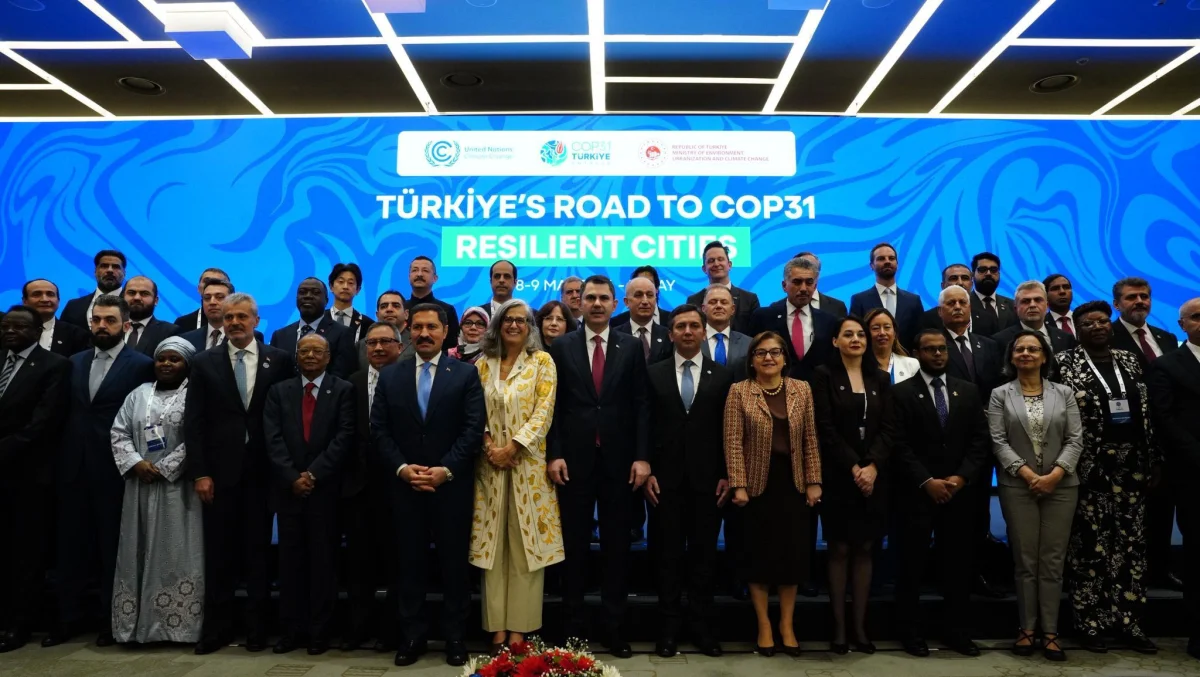
We adopt this approach not only in the earthquake region, but across all 81 provinces of our country, in harmony with our 2053 Net Zero Emissions Target and our Green Development vision. At COP31, we aim to make the support of resilient cities one of the fundamental priorities of the international climate agenda. Globally, we must reduce emissions from buildings, strengthen green building certification systems, develop new financing mechanisms for resilient cities, and expand resilient infrastructure and building standards at the global scale. These headings are not Türkiye's priorities alone — they are the shared need of cities and our responsibility toward the common future of humanity. I wholeheartedly believe that the Hatay Declaration to be prepared at the end of this programme will serve as a strong reference for cities around the world and for all humanity.
Distinguished Guests, there is a very special saying in Turkish: "Strength is born of unity." This is the spirit we need today: unity against climate change; solidarity against disaster risks; shared resolve for resilient cities. As Türkiye, we want to share all our experience in this field with the entire world and with all humanity. In particular, we stand ready to mobilise all our means to help rebuild Ukraine, Syria and Palestine — the bleeding wounds of humanity.
At the beginning of my remarks, I said that today we still carry sorrow in our hearts. As I bring my words to a close, I want to speak to you once again not of pain, but of hope. I want to speak of just one flower: the Anatolian Carnation. This flower grows on mountain peaks; despite hardship, it takes root; despite the wind, it stands tall; despite the cold, it preserves its colour. Cities, too, can be resilient like this flower — as long as their roots are strong, as long as they are people-centred, guided by science, and built upon common wisdom and solidarity.
This call rising from Hatay is not only for our country; it is for our region, for the cities of the world and for the common future of humanity. It is the call of all humanity that learns from pain, strengthens brotherhood and believes in the future. With these thoughts, I would like to thank everyone who has contributed, and all our friends who have honoured us with their participation. I hope that Türkiye's Road to COP31: Resilient Cities Programme, beginning here in Hatay, will serve as a guide for our country, our region and the common future of humanity. I greet you once again with respect and heartfelt affection.