COP31 Presidency

What is COP31?

COP31 is the 31st Conference of the Parties (COP) to the United Nations Framework Convention on Climate Change (UNFCCC). “COP” stands for Conference of the Parties. The COP is the supreme decision-making body of the UNFCCC, adopted in 1992. COP31 will take place on 9-20 November 2026 in Antalya, hosted by Türkiye.

All States that are Parties to the Convention are represented at the COP. During its annual sessions, Parties review the implementation of the Convention and related legal instruments, assess global progress, and take decisions necessary to promote the effective and coordinated response to climate change.

COP serves as the world's highest-level multilateral platform for climate governance. Where ambition is negotiated, commitments are strengthened, and collective action is advanced.

The Role of COP in Global Climate Governance

A key function of the COP is to review national communications and greenhouse gas emission inventories submitted by Parties.

Based on this information, the COP evaluates:

  • The impact of measures taken by countries
  • Progress toward the Convention's ultimate objective
  • The need for enhanced ambition and implementation

Through this structured review process, COP ensures transparency, accountability and cooperation among nations.

Over the years, COP sessions have led to major milestones in global climate action, including the Kyoto Protocol and the Paris Agreement, shaping the direction of international climate policy.
Key milestones in UNFCCC history

1992

Adoption of the UNFCCC

The United Nations Framework Convention on Climate Change is adopted at the Earth Summit in Rio de Janeiro, establishing the foundation for international climate cooperation.

1995

COP1 – Berlin

The first Conference of the Parties convenes, launching formal intergovernmental negotiations under the Convention.

1997

COP3 – Kyoto Protocol

The Kyoto Protocol is adopted, introducing legally binding emission reduction targets for developed countries.

2009

COP15 – Copenhagen

Climate change rises to the highest political level, with broad global engagement and renewed momentum for a universal agreement.

2015

COP21 – Paris Agreement

The Paris Agreement is adopted, committing all Parties to limit global temperature rise to well below 2°C and pursue efforts toward 1.5°C.

2021

COP26 – Glasgow Climate Pact

Parties strengthen commitments on mitigation, adaptation, and climate finance, reinforcing the 1.5°C objective.

2022

COP27 – Sharm el-Sheikh Implementation Plan

Agreement is reached on establishing a Loss and Damage fund for vulnerable countries.

2023

COP28 – UAE Consensus

Parties agree to transition away from fossil fuels in energy systems and accelerate the global energy transition.

2024

COP29 – Climate Finance Framework (Baku)

Parties focus on setting a new collective quantified goal on climate finance beyond the previous $100 billion commitment, aiming to scale financial flows for developing countries.

2025

COP30 – Implementation and NDC Alignment (Belém)

COP30 centers on strengthened Nationally Determined Contributions aligned with the 1.5°C pathway and accelerating implementation ahead of the next ambition cycle.

2026

COP31 – Antalya

COP31 convenes to advance implementation, strengthen cooperation, and accelerate delivery across finance, technology, and resilience.

COP: From Negotiation to Implementation

COP is not only a negotiation forum. It is a global platform that brings together governments, finance, business, and civil society to turn climate commitments into action.

Beyond decision making, COP catalyzes finance, technology deployment, resilience, and coordinated implementation at scale.

Climate finance mobilization

Aligning public and private capital with mitigation and adaptation goals, while strengthening financial access and support for developing countries.

Technology Transfer and Capacity Building

Facilitating the deployment of low-carbon and climate-resilient technologies, and enhancing international cooperation through knowledge sharing and technical assistance.

Adaptation and Resilience Strategies

Advancing policies and practical measures that enhance the resilience of vulnerable communities, ecosystems, and economies to climate risks.

Public–Private Partnerships

Enabling structured collaboration between governments, industry, and financial institutions to accelerate climate solutions and investment.

Innovation and Implementation

Promoting scalable, results-oriented solutions that translate commitments into measurable outcomes on the ground.

COP31 – Antalya, Türkiye (2026)

COP31 marks the 31st session of this global process and will be hosted by Türkiye in 2026.

Building on the foundations of previous COPs, COP31 aims to advance dialogue, strengthen consensus and accelerate implementation. As the host country, Türkiye will work with Parties and stakeholders worldwide to contribute constructively to the global climate agenda.

COP31 Türkiye emblem
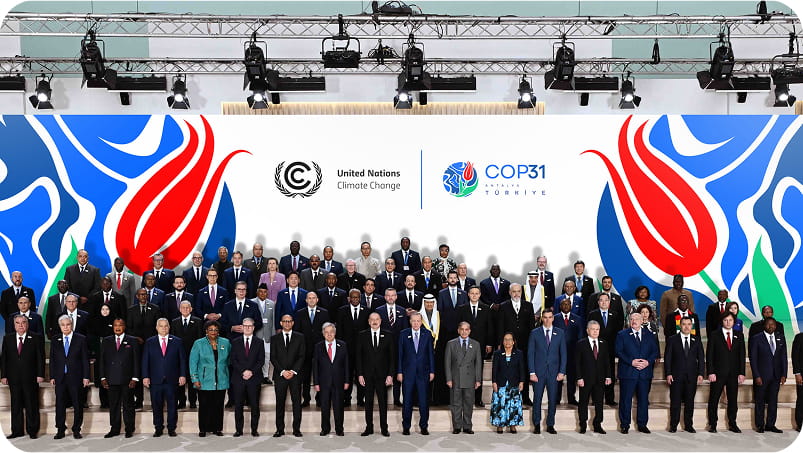
COP31 Antalya group photo