COP31 President-Designate Murat Kurum issues rallying cry to close climate finance ‘chasm’ at Istanbul Climate Finance Summit (ICFS)

- Kurum issues urgent call for world leaders to prioritise climate finance, and to treat it on par with defence spending as a strategic security priority
- Issues appeal to world leaders to “show stronger, bolder and more concrete political will on climate action”
- UNDP named as delivery partner for the Climate Implementation Bridge (BRIDGE), a flagship COP31 Presidency initiative that will speed up delivery of finance
- Istanbul Declaration welcomes BRIDGE and commits to greater cooperation between Multilateral Development Banks (MDBs), Multilateral Climate Funds (MCFs), International Finance Institutions (IFIs) and other partners
Istanbul, 4 September, 2026
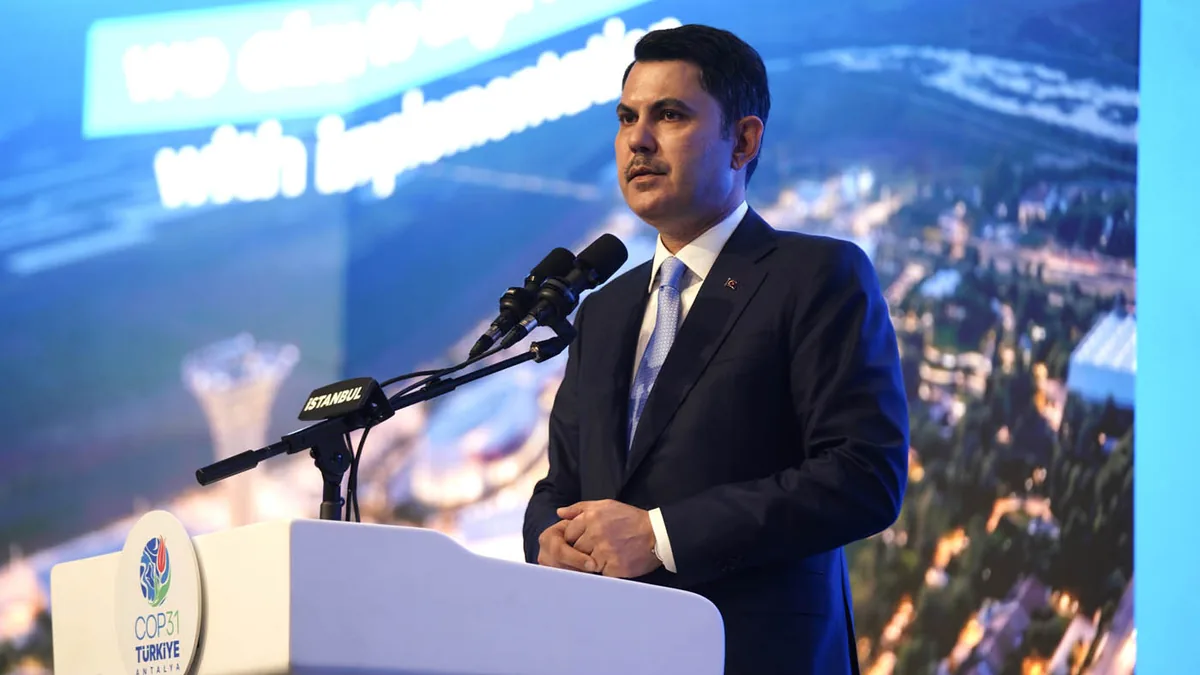
COP31 President-Designate Murat Kurum today issued a powerful call to action for the world to close the climate finance “chasm” that “we must close”. This call to action was made during the first day of the Istanbul Climate Finance Summit, which is bringing together private banks, international financial institutions, multilateral development banks, multilateral climate funds and a host of other entities to raise ambition and drive progress on climate finance on the Road to COP31.
Kurum also argued for climate finance to be treated as a strategic security priority, in the same way that countries are raising their long-term defence spending.
He said “The world is redefining what security means. NATO countries have embarked on a major transformation that will see defence-related investment rise to as much as 5 per cent of GDP. We expect to see ambition on a similar scale when it comes to climate security.”
“After all, defence spending is considered an investment made today to protect against the threats of tomorrow. Climate investment must be viewed through precisely the same strategic lens.”
“The question could not be clearer: if we no longer have a safe world to live in, what purpose will all our spending to defend our countries serve?”
Finance is a key priority for this year’s UN climate summit, COP31, that will be held from 9-20 November in Antalya, Türkiye. The COP31 Presidency has made clear the vital role that climate finance plays in both rebuilding trust in the COP process and in implementing the concrete progress that people around the world expect.
Kurum said “Today, we issue a clear call to leaders around the world: the time has come to show stronger, bolder and more concrete political will on climate action. We urgently call on every world leader to commit greater resources to clean energy, electrification, resilient cities and green industry—and to unite behind the global resolve needed to accelerate this transformation.”
This call to action was supported by sessions at the Istanbul Climate Finance Summit, including consultations and events with financial actors on key Presidency priorities including resilient cities and how to scale up climate finance to meet the Presidency’s flagship “35-by-35" electrification target.
The Climate Implementation Bridge (BRIDGE), a flagship initiative of the COP31 Presidency also took a major step towards operationalization, as the UN Development Programme (UNDP) was announced as BRIDGE’s delivery partner.
The BRIDGE will play a key role in closing the gap between climate ambition and capital deployment, offering country-driven implementation support to help countries turn their climate and development priorities into finance-ready portfolios of projects.
UNDP’s work as delivery partner will ensure that the BRIDGE leverages the established delivery infrastructure across the UN system, ensuring support can be provided quickly and effectively.
During the afternoon, the COP31 Presidency also unveiled the Istanbul Declaration on Climate Implementation and Finance, signed by multilateral development banks, development finance institutions, climate funds, international organizations, United Nations entities, national and local governments, city networks, private sector representatives, institutional investors, commercial financial institutions, philanthropic organizations, and partner institutions.
In the declaration, signatories welcomed the BRIDGE, acknowledged the importance of the COP31 Presidency’s electrification target to increase electricity's share in global final energy consumption to 35 per cent by 2035 and committed to greater collaboration to drive faster, better coordinated action.
This collaboration ranges from enhancing institutional and technical support through to supporting integrated local urban financing facilities, technical assistance, and capacity networks. It will also support efforts to institutionalize coordination across COP31 and future Action Agendas and leveraging regional and international financial centers to strengthen investment partnerships and capital mobilization for climate implementation.
This declaration is an important part of the COP31 Presidency’s engagement with Development Finance Institutions, International Finance Institutions and Multilateral Development Banks. These organisations will play a vital role in scaling up climate finance, and in supporting the Presidency’s key priorities.
Commenting on Istanbul Climate Finance Summit, COP31 President-Designate and Minister of Environment, Urbanization and Climate Change Murat Kurum said “COP needs to become a place where we can seize the opportunities of climate action and produce concrete outcomes that address the real challenges people face. Finance is essential to this effort. Without finance, there is no implementation.”
He described ICFS as “A dedicated space on the way to Antalya focused on how financial actors can both support the priorities of the Presidency, from electrification, to waste, resilient cities, oceans and beyond,” that would “determine what the financial sector can do to catalyze and leverage finance at a far greater scale.”
Commenting on the state of climate finance, Minister Kurum said:
“Our climate finance needs stand at between $7.5 trillion and $9 trillion. Yet the world currently invests only around $1.9 trillion. I call that difference a chasm—and it is a chasm we must close.
Without exception, we must all stop treating climate finance as a cost. We must recognise it for what it truly is: a strategic investment made today to avert far greater economic and social losses tomorrow.
The world is redefining what security means. NATO countries have embarked on a major transformation that will see defence-related investment rise to as much as 5 per cent of GDP. We expect to see ambition on a similar scale when it comes to climate security.
After all, defence spending is considered an investment made today to protect against the threats of tomorrow. Climate investment must be viewed through precisely the same strategic lens.
The question could not be clearer: if we no longer have a safe world to live in, what purpose will all our spending to defend our countries serve?
The real challenge is not simply to defend our countries. It is to leave future generations a liveable world that is worth defending.
Today, we issue a clear call to leaders around the world: the time has come to show stronger, bolder and more concrete political will on climate action.
We urgently call on every world leader to commit greater resources to clean energy, electrification, resilient cities and green industry—and to unite behind the global resolve needed to accelerate this transformation.