SURFF: From Finance to Implementation for Climate-Resilient Cities

Developed by İLBANK under the COP31 Action Agenda, SURFF aims to turn cities' climate targets into finance-ready investment projects. It is not a new fund; it connects existing financing resources, technical capacity and local needs.
The impacts of climate change are being felt increasingly in cities. Extreme weather events, water stress, disaster risks and rapid urbanisation are placing growing pressure on water, energy, transport, housing and infrastructure systems, making the transition towards more climate-resilient cities a central priority on the global climate agenda.
Today, the role of cities in countries’ climate targets is far more visible than in the past. While national climate commitments increasingly address urban issues and the enablers of urban climate action, urban climate finance has not yet gained equivalent prominence in these frameworks.
This raises an important question: How can climate targets for cities be translated into implementable investment programmes and investment-ready projects?
Developed under the COP31 Action Agenda, the Sustainable Urban Resilience Financing Facility (SURFF) seeks to answer precisely this question. SURFF aims to bridge the disconnect between national climate policy and delivery in cities, accelerate urban resilience investments and support the translation of climate targets into tangible results on the ground.
Cities’ Climate Ambition Is Growing—And So Are Financing Needs
As cities assume a growing role in addressing climate change, the scale of investment required is also increasing rapidly. Significant investment is needed, particularly in low- and middle-income countries, to deliver climate-resilient, low-carbon cities.
More broadly, current financing flows must increase substantially if urban climate finance needs are to be met. A clear financing gap remains between existing levels of finance and the resources cities require for climate investment.
The geographic distribution of finance is another major concern. The limited share of urban climate finance reaching developing countries and Least Developed Countries makes inequalities in access to finance increasingly visible.
The challenge, therefore, is not only to mobilise more finance globally. Finance must also reach the countries and cities where it is needed, be aligned with local priorities and be translated into implementable investments.
The Challenge Beyond Finance: Preparing Projects for Implementation
The urban climate investment gap is not driven solely by a lack of ambition or commitments. Although countries are increasingly integrating cities into national climate policy, major challenges remain in translating these targets into finance-ready urban investment pipelines.
Making a city more resilient requires not only identifying the investments needed, but also prioritising them, preparing them technically and financially, matching them with appropriate financing sources and subsequently implementing them effectively.
Cities may lack the institutional and technical capacity needed to develop finance-ready investment pipelines. Project preparation can proceed in isolation from financing mechanisms. Even where financing is available, further bottlenecks may arise in planning, procurement, inter-institutional coordination, contract management and the monitoring of implementation performance.
SURFF therefore addresses finance not in isolation, but as part of an interconnected process encompassing planning, project preparation, financing and implementation.
From Climate Targets to Investment-Ready Projects through SURFF
SURFF’s core objective is to accelerate cross-sectoral urban resilience investment in low- and middle-income countries by closing the disconnect between national climate policy and delivery at the urban level.
To this end, it seeks to support countries and cities in converting climate commitments into tangible investment programmes and investment-ready projects that respond to local needs. In doing so, it aims to forge a stronger connection between the targets set out in Nationally Determined Contributions and investments delivered in cities.
At the heart of this approach is the principle of “transformation through implementation.”
SURFF envisages not only project preparation, but also stronger national coordination and governance for resilient urban investment, greater institutional readiness to manage and deliver projects, and partnerships capable of scaling investment within and across countries.
SURFF Is Not a New Fund
One of SURFF’s defining features is that it is not designed as a new financing fund.
A wide range of initiatives in urban resilience is already being implemented by international financial institutions, multilateral development banks, climate funds, United Nations agencies, development partners and city networks. Rather than establishing a new financing mechanism to replace these structures, SURFF aims to strengthen synergies among existing initiatives, financing instruments and implementation mechanisms.
Within this framework, it seeks to mobilise public and private finance, engage international financial institutions earlier in the project cycle and improve municipal access to existing financing resources.
It also aims to strengthen the connection between investment-ready project pipelines, financing resources and implementation capacity.
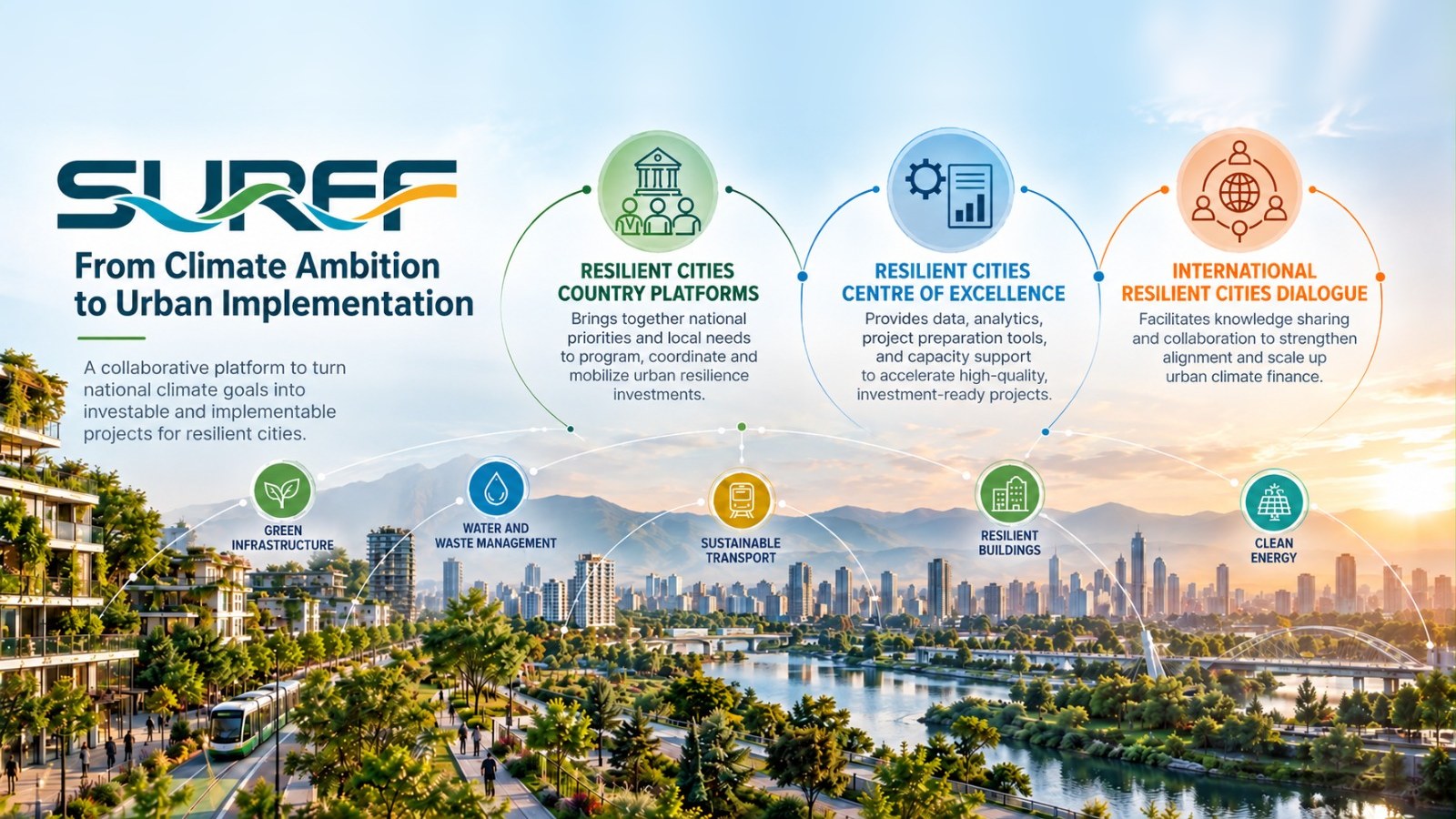
SURFF envisages delivering this approach through three core mechanisms: the Resilient Cities Country Platforms, the Resilient Cities Centre of Excellence and the International Resilient Cities Dialogue.
Resilient Cities Country Platforms: From National Targets to Local Investment
One of SURFF’s core components, the Resilient Cities Country Platforms, is conceived as a country-led structure connecting urban resilience priorities with project preparation, financing and implementation support.
Country Platforms aim to bring international financial institutions, multilateral development banks, climate funds, United Nations agencies, city networks and technical partners together within a common structure to support the translation of NDC 3.0 plans into investment-ready projects in cities.
Through the Platforms, countries will develop investment programmes aligned with climate targets and local development plans, mobilise public and private finance, prepare cross-sectoral and bankable project pipelines, and strengthen cities’ planning, project preparation and implementation capacities.
This structure offers a model through which financing institutions and other development partners can engage earlier in the process, rather than cities beginning to seek finance only after projects have been prepared. Country-level platforms are thus expected to support the translation of urban climate targets into tangible investment programmes through an approach adaptable to different country contexts.
Resilient Cities Centre of Excellence: Turning Knowledge into Implementation Capacity
Scaling urban resilience investment requires not only finance, but also strong technical and institutional capacity.
SURFF’s second component, the Resilient Cities Centre of Excellence, aims to consolidate implementation experience, methodologies and knowledge from different countries and cities into common tools and approaches.
Working closely with Country Platforms, the Centre will provide the analytical and technical support needed to translate resilience priorities into prioritised, investment-ready project pipelines.
This will include the development of methodologies and tools for resilience diagnostics, investment needs assessment and prioritisation, as well as project preparation and investment readiness.
The Centre will also promote knowledge exchange among cities and institutions through training, workshops and peer learning, while supporting the development of technical guidance and knowledge products.
It will operate as a collaborative platform through which UN-Habitat, United Nations agencies, multilateral development banks, international and bilateral development partners, city networks and technical organisations can participate in joint learning and methodology development. In this way, it will support the exchange of experience across countries and cities, strengthen common approaches and build institutional capacity for urban resilience.
International Resilient Cities Dialogue: From Shared Experience to Global Cooperation
Although the urban impacts of climate change vary across geographies, many countries and cities face similar challenges in access to finance, project preparation, institutional capacity and implementation.
The International Resilient Cities Dialogue, one of SURFF’s components, aims to strengthen the global exchange of experience and solutions around these shared challenges.
The Dialogue is conceived as a multistakeholder platform convening national and local governments, international financial institutions, multilateral development banks, climate funds, development partners, United Nations agencies, city networks and other stakeholders.
Through this platform, SURFF seeks to strengthen policy dialogue on financing and delivering resilient urban development, build new partnerships and facilitate the exchange of implementation experience across countries.
In this way, it aims to create a basis for international cooperation that supports continuous exchange of knowledge, experience and solutions among stakeholders involved in financing and implementing urban resilience investment.
COP31’s Approach: From Dialogue to Consensus, and from Consensus to Action
The COP31 Presidency’s emphasis on dialogue, consensus and action finds a tangible expression in SURFF’s three core components. The International Resilient Cities Dialogue contributes to dialogue by strengthening the exchange of experience and solutions among countries, cities, financing institutions and development partners. The Resilient Cities Country Platform brings national priorities, local needs and stakeholder contributions together within a common framework, supporting the identification of priorities and investment areas and thereby helping to create a shared basis for implementation. The Resilient Cities Centre of Excellence strengthens the action dimension by translating the resulting knowledge, experience and common approaches into technical capacity, project preparation processes and implementable investment pipelines.
Within this framework, SURFF’s components are not viewed as stand-alone structures, but as complementary mechanisms through which dialogue generates knowledge and experience, this body of knowledge is shaped around shared priorities and partnerships, and ultimately translated into tangible investment and implementation. COP31’s approach of “dialogue, consensus and action” is thus supported by a concrete delivery model for urban climate and resilience investment.
Türkiye’s Role in Urban Resilience
SURFF stands out as an approach developed by İLBANK, under the coordination of the COP31 Presidency and within Climate-Resilient Cities—one of the ten pillars of the Action Agenda—and shaped through consultations with international stakeholders.
SURFF is being structured as a multistakeholder approach developed under the COP31 process to support the translation of urban resilience targets into tangible investments and shaped through consultations with international stakeholders.
Türkiye’s implementation experience in infrastructure and urban resilience, gained in partnership with international financial institutions, provides an important foundation for the approach developed under SURFF.
This approach aims to connect urban resilience priorities with investment and financing processes, strengthen project preparation and implementation capacity, and promote knowledge and experience exchange among countries, cities and development partners.
These objectives are expected to be supported through the complementary mechanisms of the Resilient Cities Country Platform, the Resilient Cities Centre of Excellence and the International Resilient Cities Dialogue.
By operating together, these structures aim to adapt the knowledge, methodologies and implementation experience developed under SURFF to the needs of different countries and cities and to support urban resilience investment at greater scale.
An Approach that Strengthens Cities’ Access to Finance
One of the central challenges in urban climate finance is the gap between the availability of financing resources and cities’ capacity to access them.
The existence of a municipal investment need does not in itself make that investment finance-ready. The investment must be linked to local and national climate targets, prioritised, technically prepared and matched with an appropriate financing mechanism.
SURFF aims to support this process by addressing the different stages of the project cycle together.
In particular, early engagement by international financial institutions can help align cities’ project preparation processes with financing institutions’ expectations. This makes it possible to consider financing and implementation dimensions while investment priorities are being defined, rather than seeking finance only after project preparation is complete.
This approach is important in ensuring that urban climate targets do not remain confined to policy documents, but are translated into implementable investment pipelines.
From Local Needs to Global Climate Targets
Building cities’ resilience to climate change is not a transformation that can be achieved through a single sector.
Investments across water and sanitation systems, energy, transport, housing and other areas of urban infrastructure need to complement one another.
SURFF’s cross-sectoral approach supports cities in addressing resilience needs through more integrated investment programmes rather than through isolated projects.
This approach can also enable national climate targets and local development priorities to be considered within the same investment framework.
In this way, it seeks to establish a stronger implementation link between investments that respond to cities’ everyday needs and countries’ international climate commitments.
A Delivery Model Extending from COP31 to Cities Around the World
As cities gain greater prominence in climate targets, one of the central questions for the period ahead will be how many of these targets can be translated into real investment.
This transformation requires not only more finance, but also prepared projects, strong institutions, the right partnerships, technical capacity and effective implementation mechanisms.
SURFF puts forward an approach that addresses these elements together.
Connecting national targets with urban investment through Country Platforms, strengthening project preparation and implementation capacity through the Centre of Excellence, and sharing experience and partnerships globally through the International Resilient Cities Dialogue constitute SURFF’s three complementary mechanisms.
This integrated structure aims to strengthen the connection between urban climate targets, financing and implementation, while supporting the translation of cities’ resilience priorities into tangible, implementable and investment-ready investments.
A Future in Which Climate Targets Deliver Tangible Results in Cities
The success of global climate targets is closely linked to the extent to which their results become visible in cities.
More resilient infrastructure systems, local governments better prepared for climate risks, municipalities with access to finance and investment-ready project pipelines are the tangible expression of climate policy on the ground.
This is the future envisioned by SURFF: one in which every city has access to the finance, capacity and partnerships needed to deliver climate-resilient, disaster-prepared and low-carbon development.
Developed under COP31, SURFF seeks not to establish a new fund, but to enable existing financing resources, technical capacity, national policies and local investment needs to work together in a more coordinated manner.
In doing so, it aims to establish a delivery model through which climate commitments can be translated into investment programmes, investment programmes into bankable projects, and projects into tangible results in cities.
The central issue shaping cities’ climate future is no longer only defining what needs to be done, but preparing, financing and implementing the investments required.
SURFF aims to accelerate this journey from finance to implementation for climate-resilient cities.