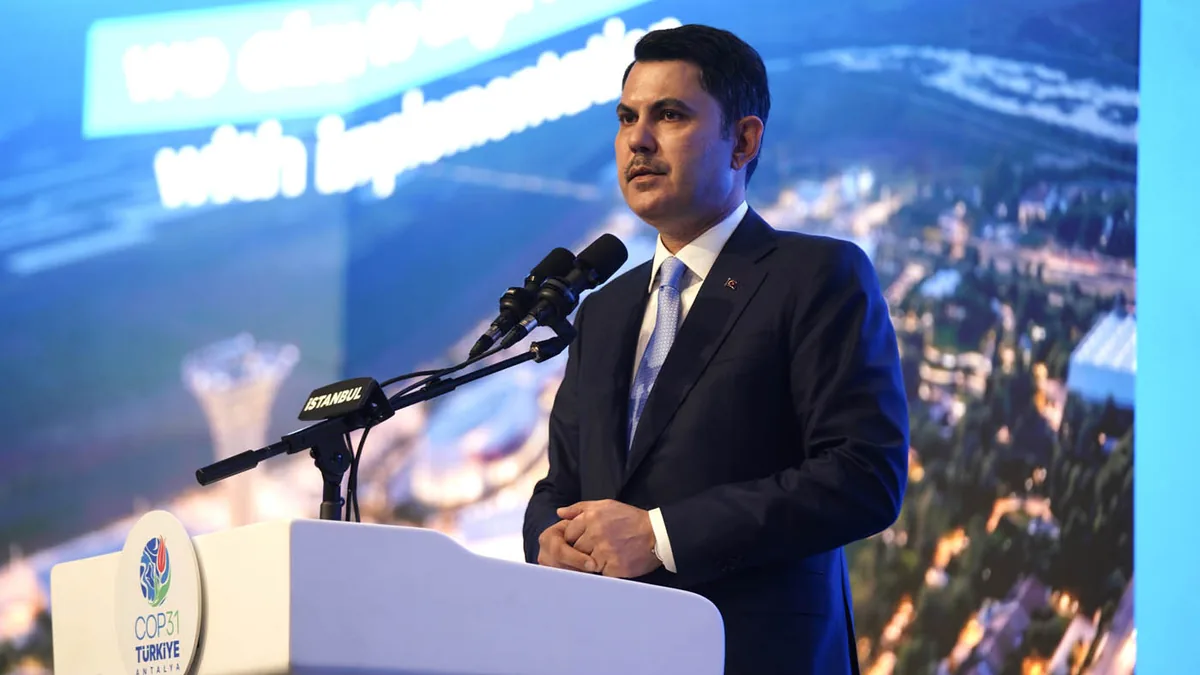
COP31 Presidency announces “35% by 2035” electrification target as part of Action Agenda launch


A flagship target for the COP31 Presidency’s Action Agenda
- Electrification target to raise share of final energy demand met by electricity from just over 20% today to 35% by 2035
- Türkiye’s COP31 Presidency also wants to halve growth in global waste by 2035
- Resilient Cities target of reducing energy consumption intensity in the building sector by at least 25% by 2035
- COP31 Presidency commissions IEA to map out pathways and analyse benefits
BONN, 9 June 2026 — COP31 President-Designate Murat Kurum today launched a new global electrification target as a flagship initiative of the COP31 Presidency’s Action Agenda, calling for a major acceleration in the shift from direct fossil fuel use to clean electricity across buildings, transport and industry. This comes as part of a wider package of non-negotiated Action Agenda initiatives and targets announced by the COP31 President-Designate today.
Speaking to delegates at the Bonn Climate Change Conference, Mr. Kurum, who is Türkiye’s Minister of Environment, Urbanisation and Climate Change, proposed a collective global goal to increase the share of final energy demand met by electricity from just over 20% today to 35% by 2035. The COP31 Presidency also committed to building a global coalition to implement actions towards achieving this target.
The target is based on analysis from the International Energy Agency (IEA) and the International Renewable Energy Agency (IRENA) and is designed to support implementation of the Paris Agreement and help keep the world on a pathway consistent with limiting warming to 1.5°C above pre-industrial levels.
During a presentation on the Presidency’s Action Agenda, Mr. Kurum also announced other targets, including a goal of halving the growth in global waste by 2035. This ambition is part of COP31’s thematic focus on achieving zero waste. Food waste in particular accounts for 10% of global emissions, primarily through methane, which is 80 times more potent than carbon dioxide as a greenhouse gas.
The COP31 Presidency also introduced a new global target under its Resilient Cities priority, to reduce energy consumption intensity in the building sector by at least 25% by 2035. This is an important step in protecting families and businesses from rising energy costs.
In addition, Mr. Kurum also shared details on new initiatives and targets being developed by the Presidency. These include critical topics such as food security, circular materials in manufacturing and climate education.
He also shared further details on the Climate Implementation Bridge, which will support countries by improving the link between national climate, economic and development priorities, helping finance reach the ground more rapidly and with greater impact.
In support of the electrification target, the COP31 Presidency, in partnership with Australia, has commissioned the IEA to deliver special reports to map out pathways to achieving the “35x35” target and to analyse the benefits of halving waste growth and boosting circular waste management systems. This follows the COP31 Presidency’s existing work with IRENA to identify how electrification can accelerate the transition away from fossil fuels.
Launching the initiatives, COP31 President-Designate, Minister of Environment, Urbanization and Climate Change of Türkiye, Murat Kurum said:
Notes to editors
The Bonn Climate Change Conference is taking place from 8–18 June 2026 and is an annual meeting of negotiators from Parties to the UN Framework Convention on Climate Change, ahead of the annual COP summit, which will be held in Antalya, Türkiye, this November.
The COP31 President-Designate addressed the opening plenary of the Bonn Climate Change Conference on 8 June, where he noted “how risky it is to remain dependent on imported fossil fuels, and how urgent it is to speed up the clean energy transition.”
On 9 June, the Presidency outlined its Action Agenda, which focuses on the real-world decisions that will shape the transition: families choosing electric vehicles and appliances, businesses investing in electric industrial processes, cities electrifying public transport systems, and building owners installing solar panels, batteries and heat pumps.
Electrification must be accompanied by wider efforts to transition away from fossil fuels in energy systems, expand renewable energy generation, strengthen electricity grids and storage, and increase energy access and financial support for developing countries.
The new target builds on a series of complementary pledges agreed at previous climate conferences. At COP28, countries agreed to work towards tripling renewable energy capacity and transition away from fossil fuels. At COP29, governments and stakeholders supported efforts to expand energy storage and modernise electricity grids, and then set a target to mobilize at least $300 billion a year by 2035 to enable action in the developing world. The COP31 Presidency underscored that an electrification target provides the next logical step in this global architecture for the energy transition by helping translate those commitments into changes in how energy is consumed across the economy.
The COP31 Presidency also recognised that different countries and sectors will follow different pathways according to their circumstances. The COP31 Action Agenda will therefore bring together governments, businesses, financial institutions, cities and civil society to accelerate implementation of practical climate solutions alongside the formal negotiations process. This aims to leave a legacy that can be continued at COP32 in Ethiopia and beyond to meet these targets by 2035.